I leave Santiago Wednesday night, so these are my last few days of working. Mostly it'd wrapping stuff up and polishing, but I got that done two weeks ago. Nowadays it's busywork. I figure that it's high time to explain what I actually did all summer.
Take a metal. All of the atoms and stuff in the metal are arranged in a neat periodic lattice. Now squish atoms together, twist them around, and generally screw up the orderliness of the lattice. This is called a defect. A dislocation, to be more precise. Defects play a major role in the properties of materials. It pays to know many there are the ratios of the various types. Until recently the only ways to do this were 'guess' and 'zap it with x-rays'. My professor has come up with a theoretical method of finding defects with ultrasound. Ostensibly my job was to confirm or reject this theory
In order to confirm it we have to compare it to a method with known validity. Before I came in the professors decided 'guessing' was too vague and that crystallography was the way to go. The idea is that x-rays scattered off a crystal would form bright, intense peaks. Defects would cause the peaks to be a little dimmer and a little wider. This is called broadening. Measure the amount it broadens and you're done. Simple, right?
Not really. Due to QM effects it's impossible to get a single, nice peak without a particle accelerator. You can only get double peaks, where the two overlap so much it's impossible to tell where one ends and the other begins. My professor had no idea how to separate them and brought me on for the sole purpose of doing it. In MATLAB. Which I didn't know.
It took me six weeks of teaching myself MATLAB and running through various dead ends, but eventually I figured out how to pull it off. I still finished it ahead of schedule. It's a bit of a hollow victory, though, since I feel that if I knew MATLAB from the start I could have done it in two. Ah well. This is why I'm an undergrad and not a professor.
Overall I think it was worth it. I was able to contribute significantly to the project, got things done faster than expected, and impressed my professor with what I pulled off. They haven't compared my results to the theory yet, or if they have they have yet to tell me. If it succeeds, hooray! If not, at least I learned MATLAB. It's a pretty great language.
Since then I've been writing documentation and puttering around with a simulation of a triangular lattice. Two more days and I'm done. Then comes Patagonia. The capstone of the summer.
Monday, August 22, 2011


Monday, August 15, 2011
Descent into Decadence
The NSF gave us a budget of 2600 to fly in and settle down. Our sponsor universities gave us an additional 1100 discretionary spending. The idea was that this would be just enough to live in the city, check out a few scenes, and maybe travel once or twice. Due to frugal living decisions mixed with decent trip planning, I ended up with a bigger surplus than expected. We dropped maybe 260 on Atacama and still have plenty left over. I put 240 into Patagonia tickets and set aside even more for guides/hostels/souvenirs. I still have plenty left. With only two weeks to go, it's exceedingly unlikely that I'll go over budget. Strange as it may seem, this is a problem for me. We got this money to enjoy Santiago, and if I have money left over it means I didn't experience as much as a could have. It's gonna be a looooong time before I come back here, if ever. I needed to find a way to burn through the remaining money in as productive a way as possible.
It occurred to me yesterday that I have almost no sense for local food. I've been making my own lunch and dinners. Up till now we've eaten out maybe once every other week, rarely in a place that really showcases the food. I do know a bit about the street food, the fast food, and the pub food. Specifically, I know that it's trying to kill me.
Don't get what I mean? Here are some of the more common foods you can find around here.
Empanadas: Make dough. Stuff with cheese. Deep fry.
Sopapillas: Make dough. Mix with pumpkin. Deep fry.
Churros: Make dough. Top with sugar. Deep fry.
Chorriana: Fry beef. Fry eggs. Fry onions. Put on french fries.
You might have heard about Chilean sea bass. Known here as merluza, its got a great flavor and a wonderful texture. I've had it many times and love it. What's the standard way to cook it? Deep fry. Don't forget the side of french fries.
Hot dogs and hamburgers are also popular. But because these don't have nearly enough oil in them they're almost always topped with guacamole and mayonnaise. Lots and lots of mayonnaise. If you're trying to watch your weight (or are a cheapskate) you can buy them without the guacamole. Not to say mayo is limited to here. If you don't top your sopapillas with copious amounts of hot sauce and mayo you're doing it wrong. Mayo is optional on empanadas in the same way tipping is optional in the States. I opted out once and got horrified looks from bystanders.
This would balance a little if vegetables were at all popular. And while salsa is delicious and omnipresent the only whole vegetables I've had in entrees were the fixings in sandwiches. Whatever you do, do not order a salad. I have seen salads consisting of shredded lettuce, a sliced up tomato, and a small pile of boiled potatoes. And before you say that sounds okay, keep in mind those are three separate salads. If I didn't cook for myself I'd be dead within two weeks. It's a tossup on whether it'd be from heart failure or beriberi. At least scurvy isn't a problem. You can get four pounds of oranges for like a dollar.
Sometime during Atacama I snapped. Chile has high quality beef and amazing seafood, and from what I've heard they do amazing things with them. Further, I could imagine myself going home, being asked "so what amazing foods did you try?" and replying "guac burgers". So to hell with deep fried mayonnaise. My new goal before I leave is to try as many different regional specialties as possible. Will fix the problem and give me a way to spend the rest of my money.
Sunday Tito and I decided to track down the not-very-elusive Seviche. It's cold raw whitefish 'cooked' by submerging it in lemon. Reasonably cheap and (I later found) is easy to make.

I made the mistake of eating the broth along with it, which Not A Good Idea. Once I figured this out the dish became a lot better. Definitely something I'd want to make myself in the future. Afterwards we tried conger eel, which supports my increasingly-strong hypothesis that eel is freaking awesome.
That's two down, many to go. I'm probably going to come back home a perfect sphere if my heart survives that long. Maybe I should go easy on the guacamole. Or I could start eating more raw-onion salads. The world's my oyster here. 60-cents-a-pound oyster.
It occurred to me yesterday that I have almost no sense for local food. I've been making my own lunch and dinners. Up till now we've eaten out maybe once every other week, rarely in a place that really showcases the food. I do know a bit about the street food, the fast food, and the pub food. Specifically, I know that it's trying to kill me.
Don't get what I mean? Here are some of the more common foods you can find around here.
Empanadas: Make dough. Stuff with cheese. Deep fry.
Sopapillas: Make dough. Mix with pumpkin. Deep fry.
Churros: Make dough. Top with sugar. Deep fry.
Chorriana: Fry beef. Fry eggs. Fry onions. Put on french fries.
You might have heard about Chilean sea bass. Known here as merluza, its got a great flavor and a wonderful texture. I've had it many times and love it. What's the standard way to cook it? Deep fry. Don't forget the side of french fries.
Hot dogs and hamburgers are also popular. But because these don't have nearly enough oil in them they're almost always topped with guacamole and mayonnaise. Lots and lots of mayonnaise. If you're trying to watch your weight (or are a cheapskate) you can buy them without the guacamole. Not to say mayo is limited to here. If you don't top your sopapillas with copious amounts of hot sauce and mayo you're doing it wrong. Mayo is optional on empanadas in the same way tipping is optional in the States. I opted out once and got horrified looks from bystanders.
This would balance a little if vegetables were at all popular. And while salsa is delicious and omnipresent the only whole vegetables I've had in entrees were the fixings in sandwiches. Whatever you do, do not order a salad. I have seen salads consisting of shredded lettuce, a sliced up tomato, and a small pile of boiled potatoes. And before you say that sounds okay, keep in mind those are three separate salads. If I didn't cook for myself I'd be dead within two weeks. It's a tossup on whether it'd be from heart failure or beriberi. At least scurvy isn't a problem. You can get four pounds of oranges for like a dollar.
Sometime during Atacama I snapped. Chile has high quality beef and amazing seafood, and from what I've heard they do amazing things with them. Further, I could imagine myself going home, being asked "so what amazing foods did you try?" and replying "guac burgers". So to hell with deep fried mayonnaise. My new goal before I leave is to try as many different regional specialties as possible. Will fix the problem and give me a way to spend the rest of my money.
Sunday Tito and I decided to track down the not-very-elusive Seviche. It's cold raw whitefish 'cooked' by submerging it in lemon. Reasonably cheap and (I later found) is easy to make.

I made the mistake of eating the broth along with it, which Not A Good Idea. Once I figured this out the dish became a lot better. Definitely something I'd want to make myself in the future. Afterwards we tried conger eel, which supports my increasingly-strong hypothesis that eel is freaking awesome.
That's two down, many to go. I'm probably going to come back home a perfect sphere if my heart survives that long. Maybe I should go easy on the guacamole. Or I could start eating more raw-onion salads. The world's my oyster here. 60-cents-a-pound oyster.
Saturday, August 13, 2011
Atacama: Crystal Valley
I didn't wake up sick today, unless you count "opening my eyes and finding there's a cat on my face" to mean 'sick'. He immediately jumped off and started trying to eat my glasses. Go figure. I scarfed down the remainder of last night's dinner and hopped in the van, ready to be taken to the third and final place on our itinerary.
So far we've wandered through desolate landscapes of steam and salt, meaning I was totally unprepared for today's hike. The valley is a riot of color, deep red terrain surrounding bright green mountains. From far away they look verdant and teaming with life. But this place is just as desolate as the rest of Atacama. In our hike the only signs of life were a single bird, the occasional patch of brush, and a handful of llama carcasses. Rather the green is oxidized copper. I put a few rocks in my backpack. They'll make good souvenirs.


Our guide dropped us off so we could walk along the highway. By now I've gotten a lot better at panorama shots, so capturing the landscape isn't that hard.
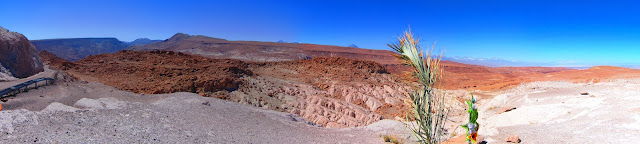

Afterwards he took us to a local farming town. The exploration was fun but we were forbidden from taking pictures . Not every part of Atacama is used to tourists. What struck me most about the place wasn't the places or the people. In one of the trees I could hear chirping birds. It was the first time since Michigan.
And with that our vacation is effectively over. We stay in Atacama a few more hours while waiting for our plane ride out. We'd expected to stay a bit longer so bought our tickets for late. No big deal.
All in all, I'm glad we did this. Coordinating the logistics was a big pain, but the rewards were amazing. The three valleys were just incredible, and the geysers weren't bad either. Between transportation, lodging, and touring fees we spent maybe 250 dollars in total. Worth it.
Two more weeks then I'm back in the US. But first comes five days in Patagonia. I'm travelling to the bottom of the world. I can't wait.
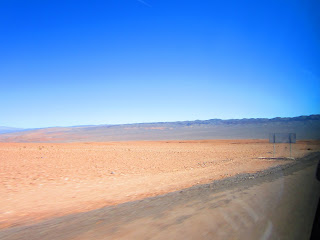
So far we've wandered through desolate landscapes of steam and salt, meaning I was totally unprepared for today's hike. The valley is a riot of color, deep red terrain surrounding bright green mountains. From far away they look verdant and teaming with life. But this place is just as desolate as the rest of Atacama. In our hike the only signs of life were a single bird, the occasional patch of brush, and a handful of llama carcasses. Rather the green is oxidized copper. I put a few rocks in my backpack. They'll make good souvenirs.


Our guide dropped us off so we could walk along the highway. By now I've gotten a lot better at panorama shots, so capturing the landscape isn't that hard.


Afterwards he took us to a local farming town. The exploration was fun but we were forbidden from taking pictures . Not every part of Atacama is used to tourists. What struck me most about the place wasn't the places or the people. In one of the trees I could hear chirping birds. It was the first time since Michigan.
And with that our vacation is effectively over. We stay in Atacama a few more hours while waiting for our plane ride out. We'd expected to stay a bit longer so bought our tickets for late. No big deal.
All in all, I'm glad we did this. Coordinating the logistics was a big pain, but the rewards were amazing. The three valleys were just incredible, and the geysers weren't bad either. Between transportation, lodging, and touring fees we spent maybe 250 dollars in total. Worth it.
Two more weeks then I'm back in the US. But first comes five days in Patagonia. I'm travelling to the bottom of the world. I can't wait.

Thursday, August 11, 2011
Atacama: The Geysers
By eight or so I start feeling a little better and can beginning getting pictures of things. Since we are going to "the geysers" these things are pretty obs geysers. Here's a few pics.


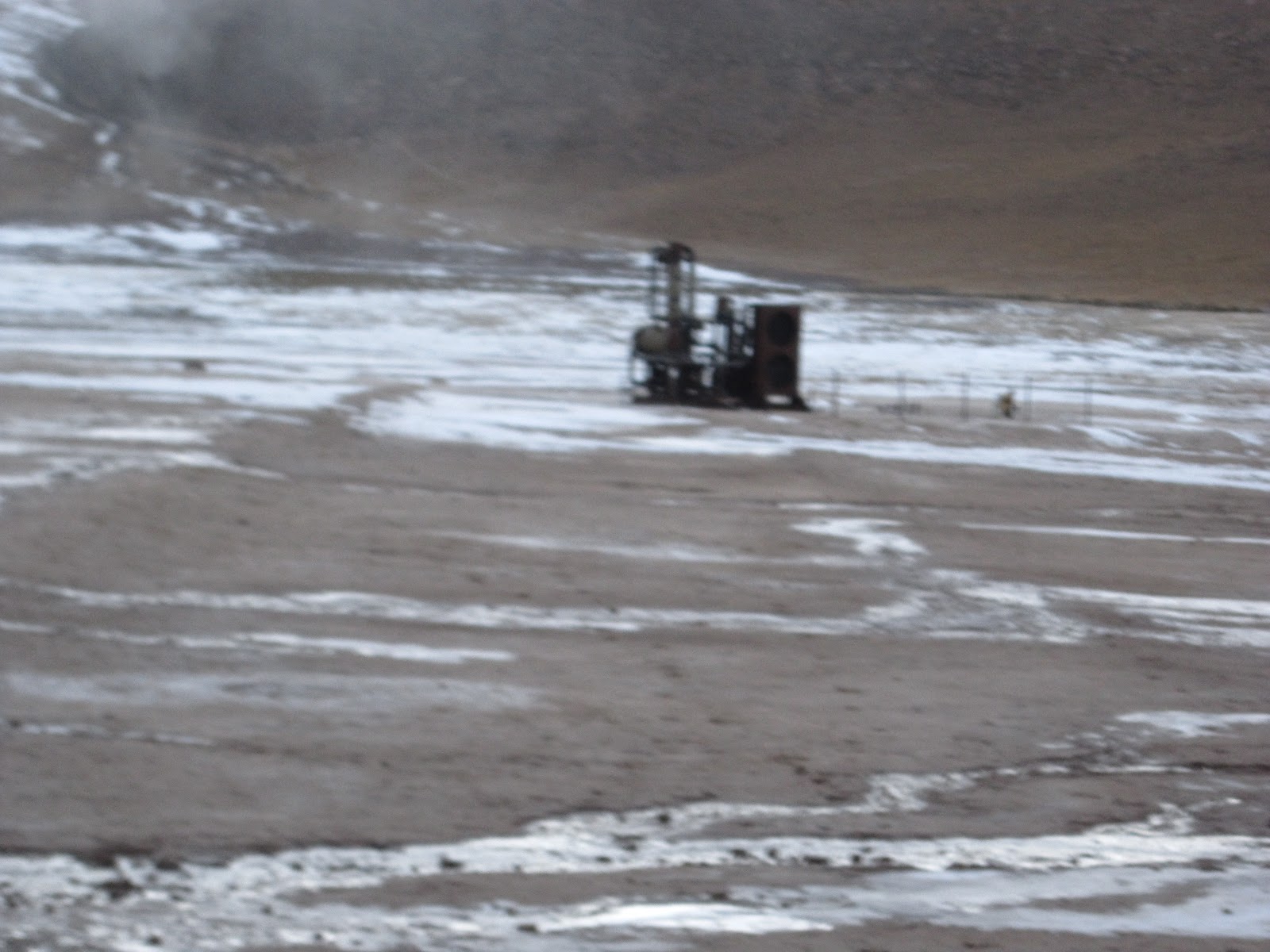
Oh hey, looks like an abandoned project got in there. The government tried to build a geothermal plant here, but decided it wasn't worth the cost.
The small vents are pretty fun, though the egg smell isn't helping my naseau. In reverse-homeopathic fashion I decide that if a little egg smell hurts me, a big egg smell must cure me. That means bigger geysers.


The last stop in the geysers is a hot spring. Everybody but me bathes here. I'm not too keen on the idea (and I don't have any other clothes), so I head off to check out the landscape.

As we head back our guide decides to make a stop at a local village. It's a tourist town in every sense of the word; only six or seven people live here. The rest are transients.


Llama is surprisingly tender.
We land back in San Pedro. I'm still a little queasy, so I pass on a hike. Instead I try to find a restaurant serving local cuisine. This takes me far out of the hostel and across the town. I was wrong about it being dead all of the time, because I was living on the very outskits. The center is bustling with life, and at times I can see more people than in a UChicago sosc class. A real sosc, not Mind.


I end the day watching the stars. We can make out the band of the Milky Way and the Southern Cross. Tomorrow is our last day in the desert, and probably the day I'm most excited about. Hopefully I won't have the same issues I did today. Guess I'll find out tomorrow.

Wednesday, August 10, 2011
Atacama: Valley of the Moon
We didn't get any sense of the desert on our arrival. We blitzed to the airport, shot into Calama, grabbed the first bus to San Pedro, landed right next to our hostel, and went to bed. So when I woke the next morning I had no expectations about what I would see. I had also done a very good job Not Learning Anything about the desert. What can I say? I hate spoilers.

Wow.
No smog. No humidity either. I think that helps with the views, letting me see further with better detail. I'm cycling these ideas as a buffer against the site. Distracting myself keeps me from being blown away.
We explore the town a little, trying to find food and supplies. 2000 people live in San Pedro. We're lucky to see a single person per block. The whole experience is a little eerie, walking through a thriving ghost town.

Eventually we pick up some food for the trail. The itinerary today is Valley de la Luna. The guides tell that we won't have time for anything else. I have no idea why it's called "Valley of the Moon." Spoilers, remember?
At three we get in the van and head into the outskirts of San Pedro. Houses and ranches soon give way into barren wasteland, then alien landscapes.


I'm not sure whether it's a testament to the strangeness of the place or my own inexperience that I've never seen anything like it before. There is no life anywhere. Eventually we stop and are allowed to get out.


We continue to a place called the Three Mary's. A local researcher thought the standing stones looked like the Virgin Mary. Here the guide explains the reasons behind both the name and the barrenness. The rocks in the valley are fifty percent salt. After heavy rains the entire place is a dull white. The first person to document it said it looked like the moon, hence the name. Gonna have to admit I find it a little poetic. This also explains why the place is so dead. The earth itself is hostile to life. Bits of salt are everywhere. In the far off mountains, on the ground beneath us,


After that we head out. Our guide decides that we've had it too easy so far and need a good hike under our belts. He stops at one ridge and points it out to us.

Then he tells us its way too dangerous and we're going on a much smaller one.

I'm not complaining.
This is the highest we've been so far. What we didn't notice down in the valley was the ever-present wind. It's harsh and dry, a white wind that seems to strip the dirt away. It also chills me to the bone. I zip up my sweater. Amazing how much the temperature changes with just a little height.
We climb back down. Our guide points out some geological strata that tell the history of the desert. White stones are heavy rains, black stones are volcanic activity. And then we drive out of the Valley of the Moon. But our tour isn't over yet. The final part, the hardest hike, is about to begin.

Welcome to the Valley of the Dead.
We are high above the desert floor. The white wind is now a constant presence whistling in my ears. There are seven of us, four other tourists, and the guide. Even so, I feel lonelier than I ever have in Santiago. Even the first day seems warm and comfortable against this. Even as I chat with Tito and Brian I can feel the isolation building up. But the loneliness is beautiful in a way. It's clean and bright. The loneliness of a sun over a snow-covered peak. I don't know how to describe it. Maybe I let myself be overly sensitive to the place, taking a placebo and calling it the real thing. I push the thoughts out of my mind as I stop with the rest and wait for sunset.


Then I see something and have to laugh.

In both valleys the only signs of life were other tourists. Not single bird going overhead, not a single fly buzzing around our heads, not a single plant tucked into the rocks. The place is too deadly for that. And yet here, at the top of the dead valley, a shrub latched onto its tiny life. I look around. More of them, scattered across the ridge in tiny clumps. I point them out of the other people. They aren't as impressed as me.
Our tour guide pulls out glasses and pours each of us a pisco sour. We sip them as we watch the sun fall.
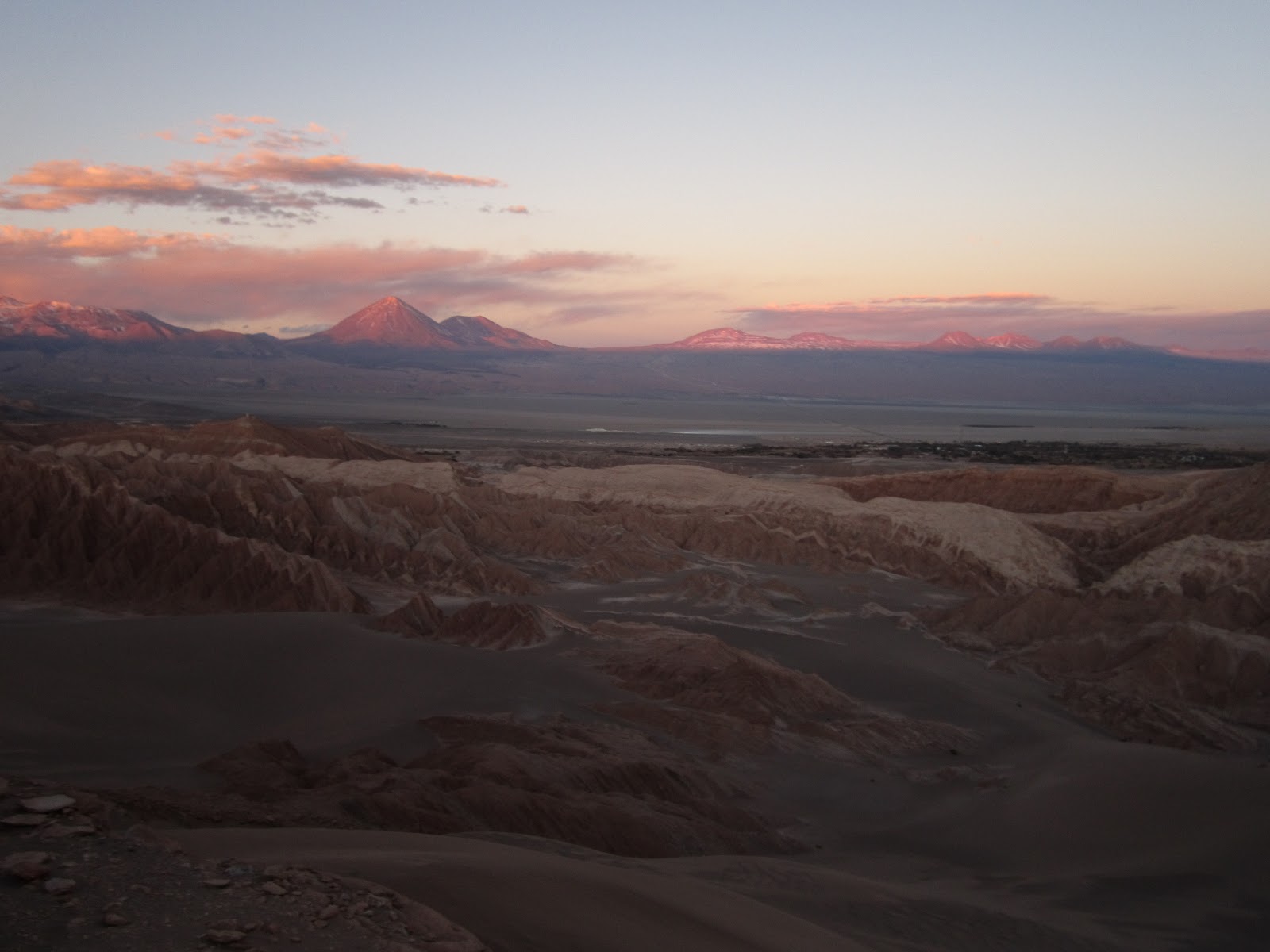
Getting back is slightly harder. Instead of taking the rocky valley back, we land on the dunes and slide down the sand. It's side fine our feet sink right in. We are walking down a crazy slope, so steep we'd need climbing gear if it were solid. I'd like to call it impressive or amazing or eerie, but it sums up to "kinda fun." Can't be amazed by everything.

With that we head home. We have to be in bed early if we want to catch the geysers. It's been one day and already the desert has amazed and exhausted me. I'll write this and head to bed. I'm tired as hell. Sleep can't come soon enough.
Until tomorrow.

Tuesday, August 9, 2011
Atacama!
I've been preparing for this trip for like three weeks now. Hunting down cheap tickets, working out logistics, finding hostels, etc. I left work an hour early on Friday to meet with everyone else and head straight to the airport. Flying wasn't any less exciting this time around, and the airline snacks were much better. LAN airlines serves dulce de leche cookies. Keep that in mind if you need to travel around South America.
I've been busy looking over the photos and stitching together panorama shots, not to mention catching up with the day's work I missed.* I'll be making one post a day for the next three days, one for each I spent in Atacama. There's a lot of stuff to talk about. It was definitely the best weekend here so far, and will probably stay that way until Patagonia.
*Have I once talked about the details of my job? I really need to get on that.
I've been busy looking over the photos and stitching together panorama shots, not to mention catching up with the day's work I missed.* I'll be making one post a day for the next three days, one for each I spent in Atacama. There's a lot of stuff to talk about. It was definitely the best weekend here so far, and will probably stay that way until Patagonia.
*Have I once talked about the details of my job? I really need to get on that.
Friday, August 5, 2011
Rattling pots and pans
Pinochet wasn't a very nice person. He was fond of doing things like "ruining the economy" and "torturing political opponents" and "killing anybody who disagreed with him." Given a lot of people disagreed with him and a lot of people did not want to die, free speech was practically nonexistent in the country. The department secretary recalls that when people wanted to voice their complaints, they would start banging pots and pans together. It was pretty common to see whole blocks, neighborhoods, half the city take up the cry.
Last night they had a protest, aimed right at the president's office. It was probably the most violent one to date. Over 800 people were arrested. For the record, the one I participated in, with over 200,000 people marching, had... 13. That night, people once again took up the cry. From every house and apartment complex came the low, fast rattling. People want their education.
(Incidentally, talking about the protests are a surefire way to make people like you. Researchers have been tripping over each other to explain the details of the political situation. When our landlord found out that I went to one he excitedly got me to show him my pictures.)
I wasn't thinking too much of it last night. But when walking to work today I saw this:

Last night they had a protest, aimed right at the president's office. It was probably the most violent one to date. Over 800 people were arrested. For the record, the one I participated in, with over 200,000 people marching, had... 13. That night, people once again took up the cry. From every house and apartment complex came the low, fast rattling. People want their education.
(Incidentally, talking about the protests are a surefire way to make people like you. Researchers have been tripping over each other to explain the details of the political situation. When our landlord found out that I went to one he excitedly got me to show him my pictures.)
I wasn't thinking too much of it last night. But when walking to work today I saw this:

Right on the middle of the main road. Looks like they're preparing something big. I've been refreshing a few local news sites but nothing's shown up yet. Whatever it is, I'll be glad to be out of Santiago for the weekend.
Subscribe to:
Posts (Atom)